By Donald Brown, M.Sc., Ph.D., Geologist
The Fry-McVean Claims are in the prolific Uchi Sub-Province 45 miles southwest of the Pickle Lake gold mining camp. The Claims cover 12.1 square miles with 198 units. The two mile long by 500-meter-wide anomalous Riedel shear zone is an un-tested, drill-ready target with 312 geochemical gold indicator anomalies. The shear zone is called the Linjog Lake – Unnamed Lake Shear Zone (LL-ULSZ). The 312 anomalies include 58 gold anomalies.
The LL-ULSZ as a Riedel shear zone was selected for the 1,087-sample humus soil survey in 2011 because Riedel shears are known to be highly dilational structures that host Major and World Class gold deposits. The humus soil survey showed that the two-mile (3,200 meter) length of the LL-ULSZ is highly anomalous with six “Hemlo-type” gold indicator elements. Actlab’s 2011 analyses of 1,087 humus soil samples revealed 312 “Hemlo-Type” gold indicator elements, namely: Au 58 gold (Au), 64 molybdenum (Mo), 35 antimony (Sb), 90 iron (Fe), 47 bromine (Br), and 20 arsenic (As) on the two mile LL-ULSZ target. The anomalies extend across strike on sample lines over distances of 33 meters to198 meters on 28 humus soil sample lines.
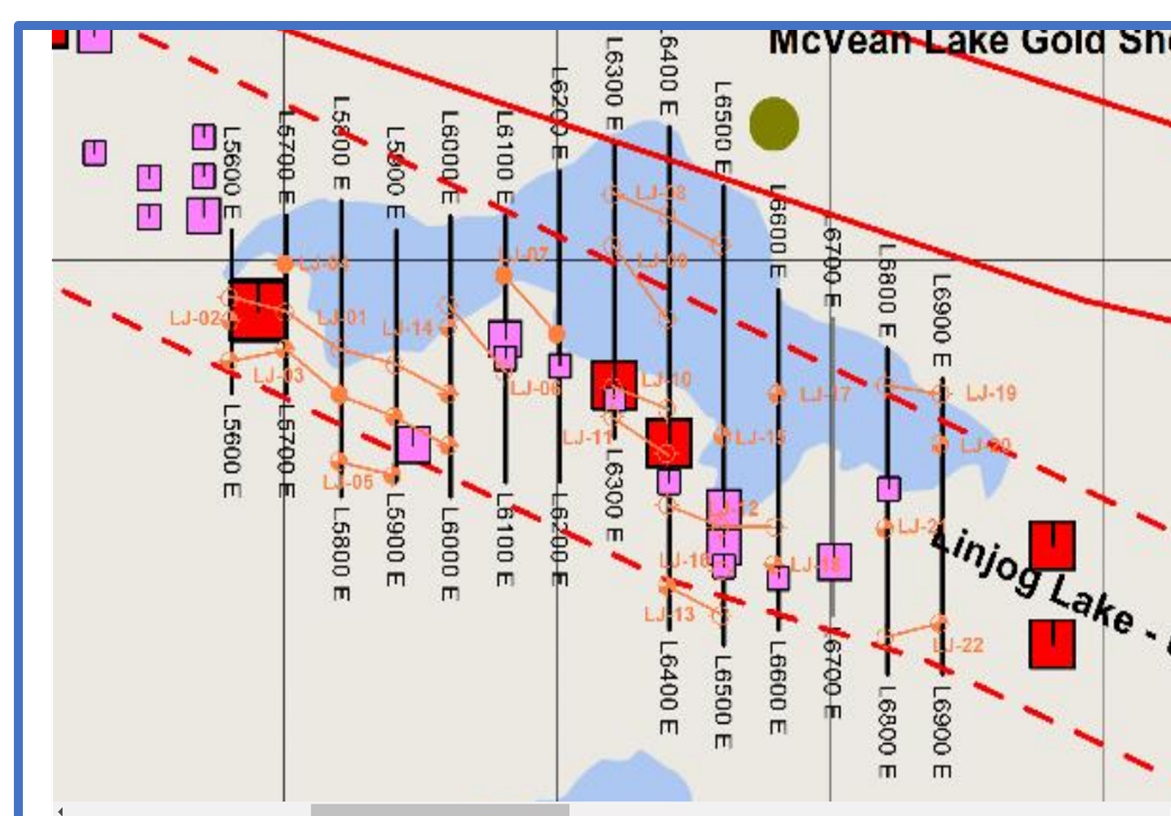
The 312 “Hemlo-Type” gold indicator elements on the two-mile-long gold target are comprised of the same six anomalous elements that were identified over the 22.5 million-ounce Hemlo gold deposit in humus soil by Fortescue, Gleeson, and Sheehan. In 2020, Abitibi Geophysics’ 17-line VLF-EM ground survey revealed 28 Karous-Hjelt Current Density (CD) anomalies that showed close spatial congruence with the gold-in-humus anomalies and a related geologic origin. The Abitibi Geophysics’ VLF-EM survey data indicates possible gold and sulphide-mineral-bearing dilational shear zones with large Current Density (CD) anomalies that are 50 to 100 meters wide in a sub panel array that extends across the 500 metre wider of the Riedel LL-ULSZ. The 28 CD anomalies are the proposed prospective drill targets. CD anomalies correspond closely to the location of the gold indicator humus anomalies as shown in the image. The gold-in0humus anomalies are shown as red and pink squares. The VLF-EM Fraser Filter conductors are shown as orange lines that contains small orange circles that are Karous Hjelt CD anomalies.
The Fry McVean 2-mile drill anomalous drill target has all four possible features of a World Class gold deposit that suggests a possible major resource potential. The deposits are hosted in dilational Riedel shear zones, can be bordered by proximal hydrothermal iron carbonate alteration zones, the Riedel shear zone can be part of a Pull-Apart structure or basin, the deposits can be surrounded by three or four felsic plutons (granite stocks) either as a Triple Point Junction (TPJ) or a Quadruple Point Junction (QPJ). The Hemlo mine and the Campbell-Red Lake World Class deposits are also on QPJ’s and on Riedel shear zones in northwest Ontario for 52.5 million ounces.
The two-mile-long gold target on the LL-ULSZ has the two geometric structural features that are associated with World-Class and giant gold deposits. The two features are: 1) the two-mile target is on a Riedel shear zone, and 2) the two-mile target is on a Quadruple Point Junction. The two World Class features have major implications for exploration of the Fry McVean gold target.
The nine World Class mines referred to above represent an average of 29 million ounces of gold. The Fry McVean two-mile drill target has features that suggest a similar possible resource potential of 14 million to 29.8 million ounces of gold. This resource potential is based on the Hemlo gold deposit model that has analogous features as the Fry McVean gold target.