Big Gold Inc. (CSE: BG) (FSE: H7L) (the “Company” or “Big Gold”) reports it has mobilized a geophysical crew to gather data in preparation for a 2024 core drilling program on the Tabor Property (“Tabor” or the “Project”), located in the heart of the Shebandowan Greenstone Belt, northwest of Thunder Bay, Ontario.
The geophysical crew will focus this phase of fieldwork on the collection of Induced Polarization (“IP”) data and resistivity (“Resistivity”) data (Figure 1) in areas that include the “East Divide zone” where Big Gold recently reported infill and re-sampling results on historical core of up to 1.5 metres (“m”) of 10.9 grams per tonne Gold (“Au”), 34.1 g/t silver (“Ag”), 0.5% copper (“Cu”), and 1.8% Zinc (“Zn”), including 0.8 m of 20.8 g/t Au, 56.9 g/t Ag, 0.7% Cu, and 3.3% Zn.
2024 Geophysical Rationale
Gold and base metal mineralization in the Shebandowan area, and more specifically on the Tabor Project and on the neighbouring properties, are most often related to geological units that exhibit higher concentrations of sulphide mineralization and shearing.
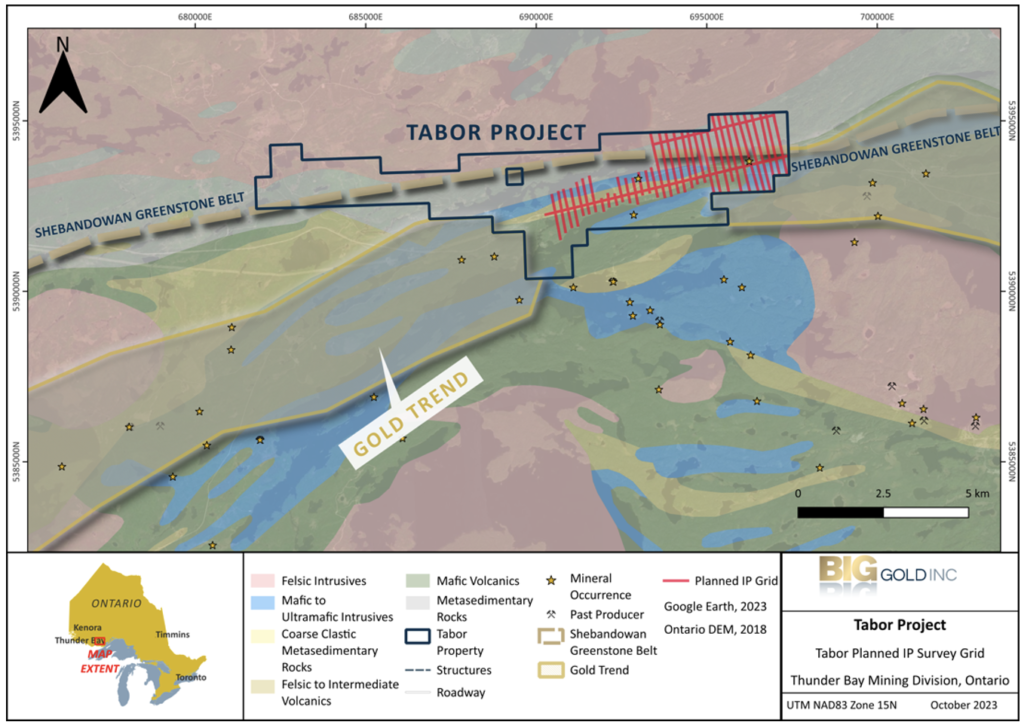
Figure 1 – Geophysical Grid Locations at the Tabor Property
The geophysical technique of collecting IP and Resistivity data is perfect for defining target areas that contain more abundant concentrations of sulphide minerals that are often associated with areas with more gold mineralization.
Recently announced re-sampling of historic drill core from a 1983 program (mentioned above) confirmed that the highest concentration of gold mineralization in the historic drill core is associated with much more abundant sulphide minerals including pyrite (iron sulphide), sphalerite (zinc sulphide) and chalcopyrite (copper sulphide). Knowing this association makes the collection of IP and Resistivity data a critical tool in the definition of drill targets for the planned summer drill program.
“The mobilizing of our geophysical crew to the Tabor Property to gather additional data that will be used in conjunction with all of the other data we have on the property, marks the start of our field work for 2024. Once we have this geophysical data collected and compiled and we have had a chance to ground-truth some of the targets, we will be in a position to create updated models that will help us better define our initial drilling campaign which we expect to launch mid-year,” remarked Scott Walters, CEO of Big Gold. He added, “Information from the work being carried out by neighbours like Goldshore and Delta will help us with our modelling and program implementation, and we feel there is a strong likelihood that the host rocks of Goldshore’s gold trend continue onto our property.”