Critical minerals for the energy transition are the focus of Canada Silver Cobalt Works Inc. (CCW) as it actively pursues exploration and development in northern Ontario and Quebec.
The company is unique among junior explorers in having such a wide range of these important minerals including nickel, cobalt, and lithium (all needed for electric vehicle [EV] batteries), copper (EVs and grid wiring), and silver (electronics and solar panels). CCW has also developed an ESG-compliant processing technique, called Re-2Ox, which produces commercial products needed by battery makers while minimizing pollution and energy use.
CCW’s most advanced property is the Castle Mine in northern Ontario’s historic Cobalt Camp, where mining produced 600 million ounces of silver and 30 million pounds of cobalt as a byproduct during the 1900s.
The past-producing Castle property has the potential to resume mining activity due to all the silver and cobalt left behind by previous miners (the mine shut down in 1989 due to low silver prices, not because metal resources were depleted), as well as the company’s recent exceptional high-grade silver discovery at Castle East, two kilometers east of the Castle Mine shafts. This discovery has grades as high as 89,853 g/t silver (2,621 oz/ton) over 0.3 meters, a rare situation in the silver mining sector where grades are commonly considered high if they reach above 1,000 g/t silver. See an example of the Castle East spectacular high-grade silver veins in the drill core photo below.
The company has already published an inferred resource estimate for the Castle East deposit and is working towards the construction of an underground exploration ramp to the high-grade veins to extract the silver, with the cost expected to be largely covered by revenue from the silver that would also pay for the production of the cobalt and nickel and any other metals that occur with the silver. Also present and can be extracted are bismuth and antimony, which are both listed as critical minerals in Canada and the U.S., as well as arsenic, which is on the U.S. critical minerals list.
Another aspect of CCW’s operations, which makes it unique and gives it an advantage over other junior companies in the Cobalt Camp, is its acquisition of the Temiskaming Testing Laboratory (TTL) in the town of Cobalt, Ont. TTL is an assay lab and bulk processing facility that served mining companies in the camp in the 1900s as a provincial government entity and has seen been updated and made fully operational by CCW.
The mineralized material from Castle and other mines in the area can easily be separated through gravity processing into two parts: a silver concentrate containing native silver and a sulphide concentrate containing cobalt and other base metals, as well as some remaining silver.
The silver concentrate can then be processed at TTL right up to producing silver dore bars with about 90 per cent silver that would then be shipped to a refinery for the final stage of conversion into pure silver bars sold in markets around the world.
The sulphide concentrate can be processed in an environmentally friendly way using CCW’s Re-2Ox hydrometallurgical process, which was developed in-house by chief executive officer Frank Basa, a highly experienced metallurgical engineer and milling expert. Re-2Ox has been shown in lab tests at the world renown SGS Laboratory in Lakefield, Ont. to successfully convert mineralized material from Castle into cobalt sulphate needed in EV batteries, and it has been configured to also produce nickel, copper, and manganese sulphates as well as extracting arsenic, antimony, and bismuth. This process, remarkably, is closed loop with no discharge and avoids the problem of pollution and energy use through smelting or burning. It further has the potential to be adapted and used widely at other mines to achieve more ESG-compliant operations.
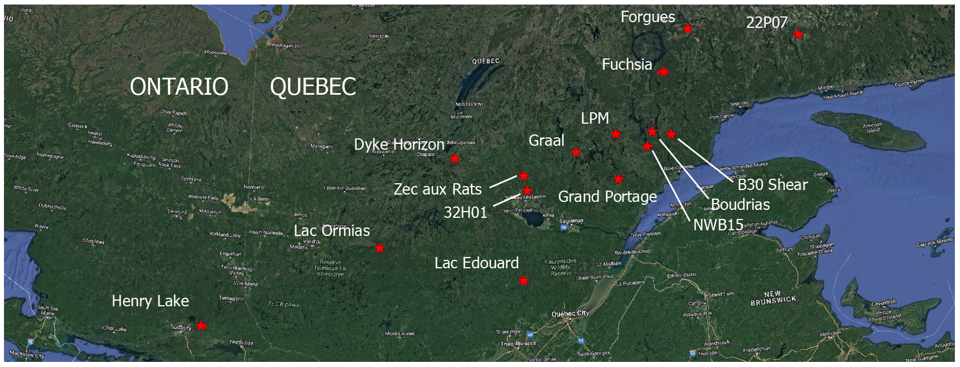
As for its battery metals properties in northern Quebec, CCW has accumulated 14 mostly early-stage exploration properties that it is evaluating. The flagship property of that initiative is the Graal property in the Lac St-Jean area, which has high-grade nickel and copper as well as some cobalt, platinum, and palladium. Lac St-Jean is slated to be spun out into a separate company soon. The Graal property is regarded by geologists as potentially being a very large mining operation as it has numerous massive sulphide lenses containing these minerals. The company has been drilling shallow targets but believes the mineralization goes quite deep based on geophysical anomalies.